Where to Put a Floor Lamp: Scenarios for the Living Room, Bedroom and Nursery
- Where to put a floor lamp: scenarios for the living room, bedroom and kids' room
- First decide what light you need: ambient or directed
- In the living room: a cosy nook and a play of textures
- In the bedroom: the armchair and the bed
- In the kids' room: quiet light for feeding and bedtime stories
- Natural materials: why they win in bedrooms and living rooms
- When the interior needs lightness
- Not only home: beauty salons and studios
- A short placement checklist
- FAQ
Where to put a floor lamp: scenarios for the living room, bedroom and kids' room
A floor lamp is the most mobile light in the home: no installation, no wiring work, just a socket nearby. That is why the question of where to put a floor lamp decides more than it seems — the same lamp in different corners of a room creates entirely different scenarios. We've gathered the placements that work best, shown on floor lamps from Ukrainian workshops.
First decide what light you need: ambient or directed
Before choosing a spot, answer one question. Ambient light is a soft pool through a diffusing shade — fabric, fringe, frosted glass. It isn't for tasks; it sets a mood and gathers a zone around itself. Directed light is the opposite: a reflector or pivoting head throws a beam exactly onto a book, a chair or a table, leaving the rest of the room in shadow.
Everything follows from this difference. An ambient lamp goes where you want cosiness, and you watch where its pool of light lands. A directed one goes where the light has a specific job. Both types live in the MAIIMO floor lamp collection, and below we show them in real rooms.
In the living room: a cosy nook and a play of textures
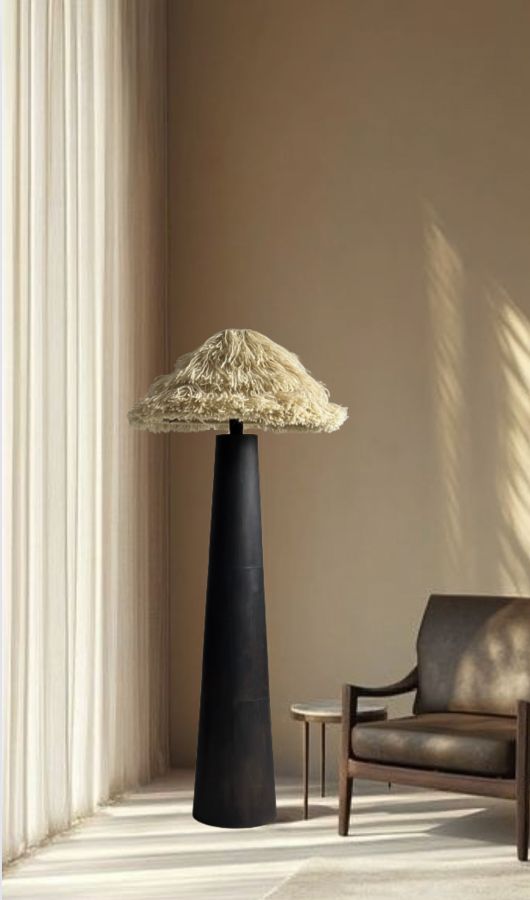
The classic spot is beside the sofa, within arm's reach. In the evening the overhead light goes off, the floor lamp stays on alone — and part of the living room becomes an island you want to stay in longer. In the example above, a black wooden base and a shaggy textile shade sit next to the leather of an armchair: three textures working together.
The second trick for a living room is contrast. If the space is built on calm tones, the lamp can be a coloured vertical that holds the eye. A navy metal cylinder with a red accent button is exactly that: it gives light and plays the role of an art object next to a sofa or a chest of drawers.

In the bedroom: the armchair and the bed
If the bedroom has an armchair, a floor lamp beside it turns it into a room within a room: a pool of warm light over the armrest, and you can finish the chapter without switching anything else on. A dark monolithic silhouette looks especially graphic in this role.

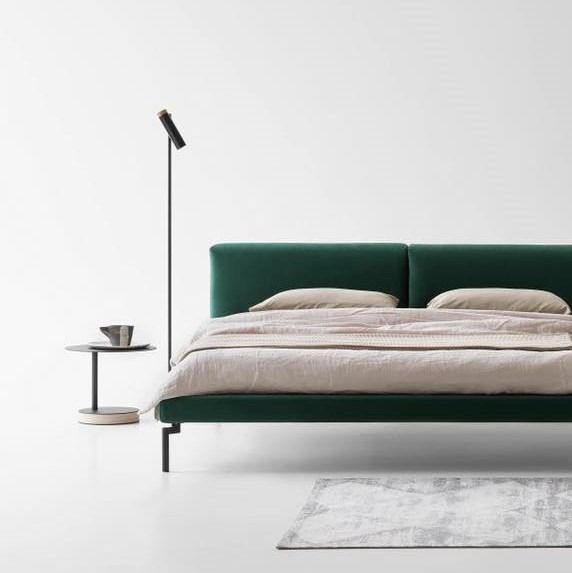
The second spot is right by the headboard, replacing a table lamp. A directed type works better here: a narrow beam on the page, the other half of the bed in darkness. A thin stem with a pivoting spot on a wooden detail takes up less floor space than a nightstand.
In the kids' room: quiet light for feeding and bedtime stories
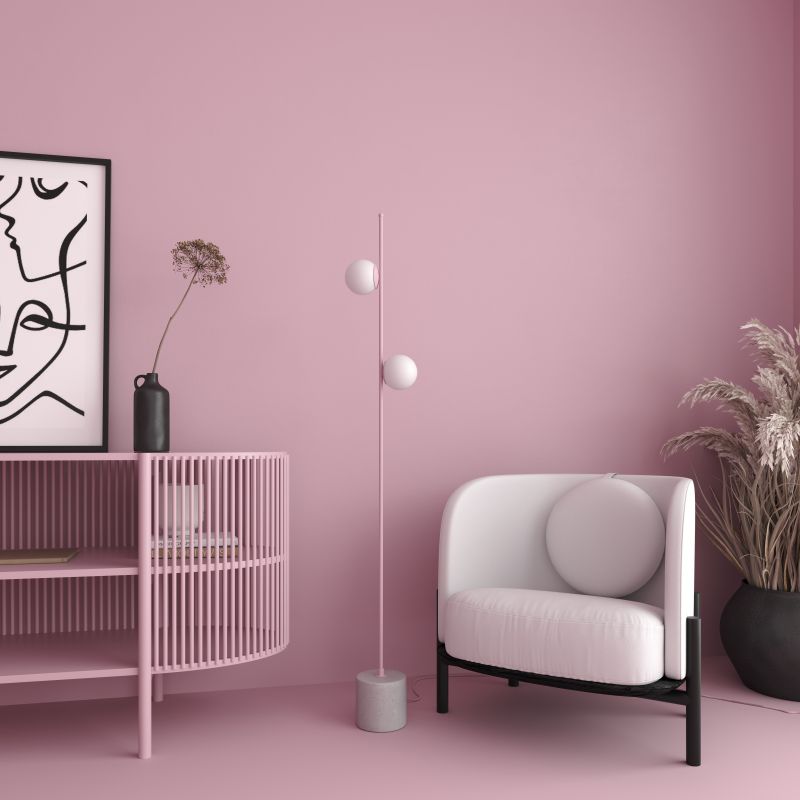
The kids' room is where a floor lamp is often more useful than a chandelier. While the baby is small, soft side light by the armchair is a lifesaver during night feeds: mum sees everything she needs, and nothing glares at the child. Later the same corner becomes the bedtime-story spot — enough light to read aloud while the child drifts off. Frosted glass globes on a thin stem give exactly that glow; alongside other kids' furniture such a lamp looks like a toy, yet stands firmly on its concrete base.
Natural materials: why they win in bedrooms and living rooms
Notice that the cosiest scenarios above all feature floor lamps in natural materials? That's no coincidence. Fabric and fringe scatter light unevenly, in a "living" way; wood in the base adds weight and warm texture where metal would feel cold. The eye reads light through natural materials as evening light — which is why the wood-and-textile Sazha or a spot on a wooden detail settle so easily into rooms meant for rest.
When the interior needs lightness
Sometimes the task is reversed: you need light, but not another object with mass. For such interiors there are line lamps — a few thin metal strokes leaning against the wall or standing at an angle, with a ring of light that seems to float. A silhouette like this barely occupies the room visually; by day you simply don't notice it.

Not only home: beauty salons and studios
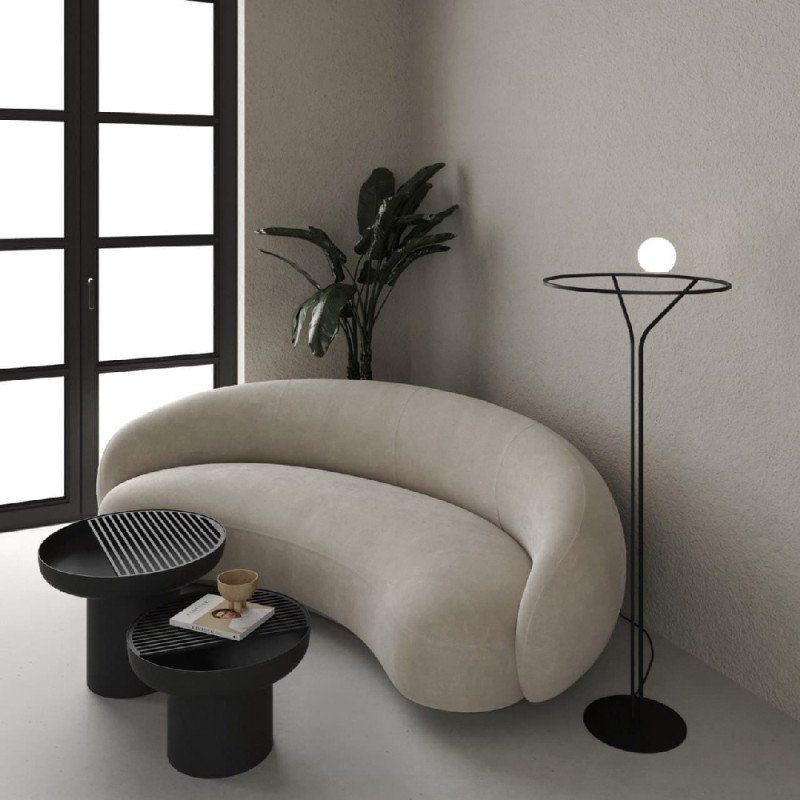
A floor lamp works in commercial spaces too. In the waiting area of a beauty salon it does what ceiling lighting can't: it makes the place feel like a living room, not an institution. A sculptural steel frame with a frosted glass globe above a curved sofa reads as part of the service — the client hasn't ordered anything yet, and the atmosphere is already premium. The same rules apply to showrooms and studios; see the furniture for business section.
A short placement checklist
The bottom edge of the shade should sit roughly at the eye level of a person seated nearby — about 100–120 cm from the floor. Keep the lamp close enough to the chair or sofa to reach the switch without getting up. Run the cable along the wall, never across a walkway. And give the lamp its own socket: a light that always needs an extension cord soon stops being switched on at all.
FAQ
Where to put a floor lamp in a small room? In the corner behind the seating — it takes no useful floor area, and light bouncing off the walls visually widens the room. For truly tight spaces, choose line models with a minimal base.
Is a floor lamp safe in a kids' room? Yes, if the model has a heavy stable base (concrete, stone), enclosed shades, and the cable runs behind furniture. Wobbly lamps on light stems are best saved for school age.
Ambient or directed — which one if you only have one lamp? Start from the main job. Reading every evening — directed. Wanting a cosy evening mood — ambient, with a separate lamp or sconce added for reading.


