Textured Paintings
When the walls become the windows into the world
Textured paintings change as the light moves: their relief appears soft in the morning and deeper, more graphic in the evening. These relief paintings bring tactile depth to a wall and work beautifully wherever an interior needs a strong but quiet focal point.
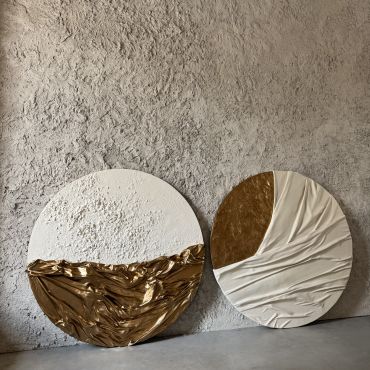
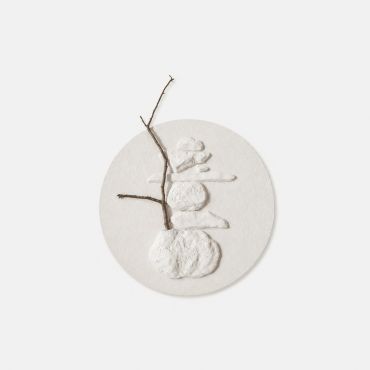
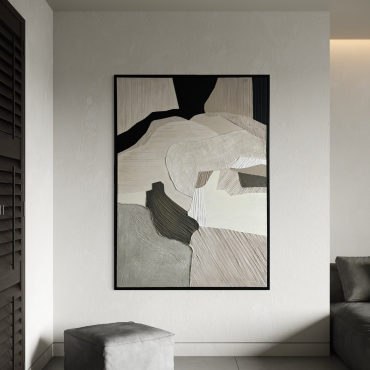
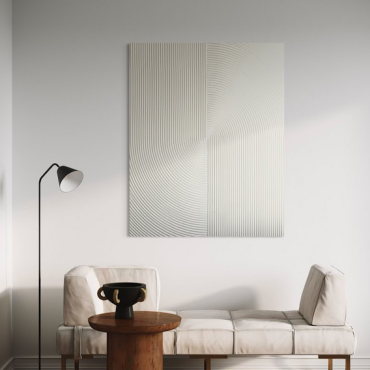
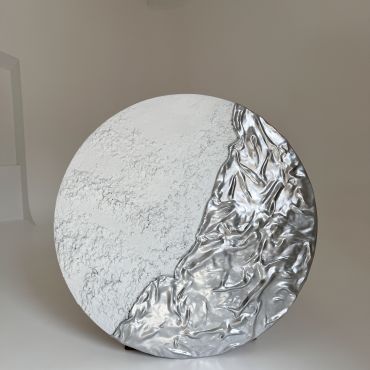
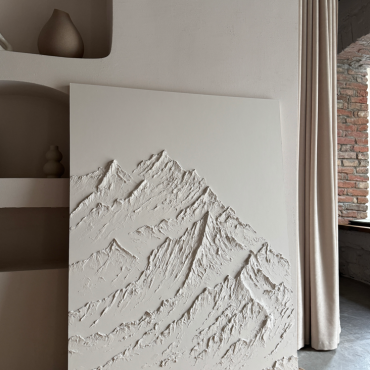
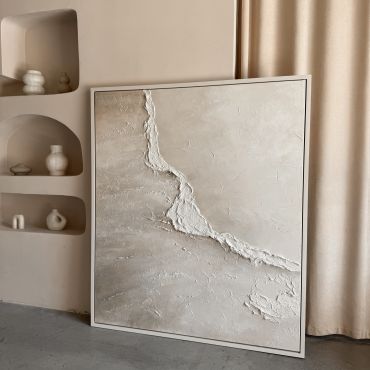
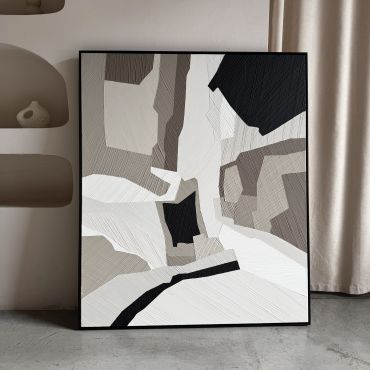
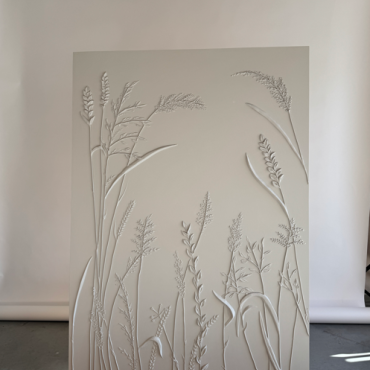
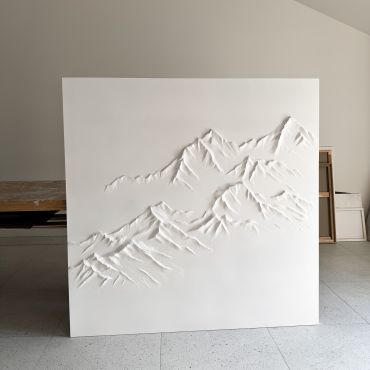
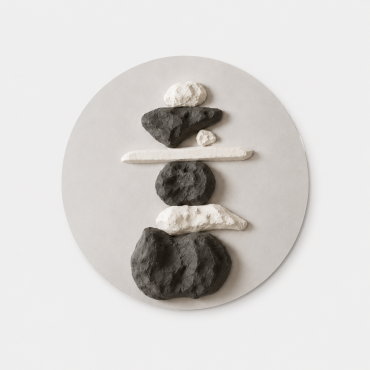
Textured paintings for contemporary interiors
Textured paintings invite more than a straight-on view. Take one step sideways and the surface catches light differently: ridges become clearer, recesses darken, and individual strokes move forward. This changing appearance makes the work feel alive. It responds to daylight, lamps, viewing distance, and angle instead of remaining a flat image throughout the day.
Unlike decor driven mainly by colour or subject, a textured painting also works through physical depth. It may be nearly monochrome and still keep the wall from feeling empty. This is useful in restrained interiors where character matters but visual noise does not. For a broader range of subjects and techniques, explore all interior paintings at MAIIMO.
We recommend starting with the role of the textured painting for an interior, not with a fashionable colour. It may anchor the wall above a sofa, support natural materials in a bedroom, define a dining area, or give an office a more tactile atmosphere. Once the role is clear, format, relief depth, palette, and visual energy become easier to choose.
What textured paintings are and how they work in a room
Textured paintings have a physically articulated surface. Relief can be subtle, like the trace of a wide brush, or deep and almost sculptural. The technique depends on the artist: layers of paint, modelling paste, palette-knife work, fibres, or decorative inclusions. Read the description of the specific piece rather than making assumptions from a photograph.
In a room, textural paintings behave more like compact wall objects than flat posters. Their relief casts real shadows and creates a fine visual rhythm. From a distance the overall composition is clear; up close, you notice tool marks, changes in thickness, and the contrast between matte and reflective sections.
This is especially effective in a neutral interior. A white or beige dimensional painting does not compete with wood, stone, or expressive upholstery, yet it adds depth to the wall. In a colourful room, the relief can echo the lines of furniture while the palette supports an existing tone without matching it literally.
We see in practice that textured paintings for interiors need some breathing room. Shelves, televisions, tall plants, and busy textiles can hide the very surface that made the piece interesting. A calm background is usually more valuable than extra decor around one substantial work.
Relief, textural, and dimensional paintings: the difference
Relief paintings, textural works, and dimensional art are often used as overlapping terms. “Textural” describes the character of the surface, “relief” emphasises changes in height, and “dimensional” points to a noticeable three-dimensional profile. One work may fit all three descriptions, although the degree of depth varies.
For a buyer, the actual profile of a textural painting matters more than the label. A light impasto stroke barely changes weight or care. Deep relief collects more dust, needs more careful packaging, and reacts more strongly to side lighting. Ask about the base, the maximum depth of protruding areas, and the hanging system.
Check whether you are looking at genuine dimensional wall art or a printed image of texture. A good print can be appropriate, but it creates a different effect: its cracks and shadows are already printed and do not change with the light. Physical relief creates a live shadow. A short angled video makes the distinction obvious.
Paintings made with modelling paste
Paintings with modelling paste are built by applying a pliable material to a prepared base. The artist forms grooves, waves, flat fields, or raised shapes and then adds colour after drying, or leaves the surface nearly monochrome. Paste composition, safe layer thickness, and finishing vary, so the product description should confirm the actual materials.
A well-made modelling-paste painting has convincing form without randomly fragile edges. Even strong relief dislikes impact. For a large piece, ask about stretcher rigidity, corner protection, and fixation inside the shipping box. Secure delivery is part of the quality of this type of work.
Acrylic, metal leaf, and other materials
Textured canvas art often combines acrylic with modelling compounds. Acrylic supports layered work and can produce matte or saturated surfaces. Metal leaf creates a local reflection that may be quiet in daylight and suddenly bright under an evening lamp. A still photograph rarely communicates that shift.
Some relief paintings for interiors include sand, cloth, paper, fibres, or other elements. Their presence is not automatically a sign of better quality. Each material should support the idea and remain firmly attached. Confirm the composition for a home with children or pets, and for public spaces with active traffic.
A plaster dimensional painting can have crisp architectural relief, but it is more vulnerable to impact and may be heavy. Do not assume that a white piece contains plaster unless the description says so. Similar effects can be produced with different compounds.
How to choose a textured painting for an interior
To choose a textured painting for an interior, treat the wall as part of the whole room. Consider furniture width, ceiling height, distance from the main viewing point, and the direction of light. Mark the proposed size with low-tack tape and look at it in daylight and after dark.
Decide how strong the focal point should be. A high-contrast abstract textured painting quickly becomes the centre of the room. A monochrome work with deep relief acts more quietly: it first supports the architecture, then reveals detail. Both can be expressive, but they set a different pace.
Check the scale of the texture. Fine relief reads well at close range in a compact room. Across a large living room, it can disappear. In that setting, large textured paintings need a composition and surface rhythm that remain visible from the doorway.
Size and wall proportions
The size of a textured painting should usually relate to the furniture beneath it rather than the entire wall. Above a sofa, console, or bed, it needs to feel connected to that object. A width between roughly one-half and two-thirds of the furniture often works, but it is a guide rather than a fixed formula.
On a long wall, a small textural painting may feel isolated. Choose a larger format, a diptych, or move the composition toward a functional zone. Filling the whole wall is unnecessary. A clear relationship with the sofa, table, armchair, or passage matters more.
A vertical dimensional wall painting can visually lift a low room and fit a narrow pier. A horizontal work supports a long sofa or headboard, while a square format feels self-contained. For a circular composition, compare the dedicated selection of round paintings.
Colour, contrast, and a neutral palette
The colour of a textured painting for an interior does not need to copy the sofa or curtains. It is more useful to support the temperature of the palette: warm cream and clay beside oak, cool grey near concrete, or blue-green accents with dark wood.
A white or beige neutral textured painting depends largely on shadow. Against a white wall it may feel subtle and architectural; against colour it appears stronger. Where marble, expressive veneer, or patterned textiles are already active, a neutral work gives the eye a pause.
A dark abstract textured painting needs adequate light. On a dim wall, black, brown, or deep blue relief can lose detail. In a bright room, the same work creates a convincing point of gravity. Compare it in daylight and evening conditions.
Lighting that reveals the relief
Side lighting for a textured painting reveals changes in height better than even frontal light. The beam skims across the surface, and small ridges cast shadows. A directional spot, track light, or wall light placed to one side can work well.
When selecting designer lighting, avoid aiming a narrow beam at one tiny area. Softer light with a sufficient spread lets the whole relief painting remain legible instead of turning it into a few isolated bright fragments.
Direct sun is not ideal permanent lighting for a textured painting. It can affect pigments, finishes, and the base. Use a sheer curtain or blind if the piece hangs opposite a large south-facing window.
A textured painting for a living room, bedroom, or office
A textured painting for a living room often belongs above the sofa, console, or dining area. It is seen from several positions, so silhouette and scale matter. In an open kitchen-living room, it can define the seating zone without a divider.
In a bedroom, a textured painting usually works best in a calmer palette and without fragile sharp projections. Secure hanging is essential above a headboard. If the weight is uncertain, place it on a side wall where it remains visible without hanging directly overhead.
In an office, textural paintings add material presence without an overly literal subject. Abstract work is less distracting during focused tasks. A large format in a meeting room can read well both in person and in the background of video calls.
In a hallway, a relief painting can set the first emotional note of the home, but a narrow passage needs restraint. Check how far the surface and frame project. Moderate relief and a strong base reduce the risk of accidental contact.
In a dining area, textured paintings for interiors can echo the line of a round or rectangular table. Keep them away from steam, grease, and open flame. A wall opposite the kitchen workspace is safer than a position over the hob.
Abstract textured paintings in contemporary styles
Abstract textured paintings adapt to many styles because they do not impose a literal subject. Yet flexibility is not randomness. Each interior needs an appropriate relief scale, line quality, colour temperature, and balance of matte and reflective surfaces.
In minimalism, a minimalist textured painting may be the only wall accent. Broad calm fields, clear rhythm, and one or two closely related tones work well. Small decorative objects nearby are usually unnecessary.
A Scandinavian room welcomes textural paintings in milk, grey-beige, dusty blue, and muted green. Relief may suggest cloth, sand, or stone. Light wood, wool, linen, and matte ceramics make natural companions.
For a loft, dimensional paintings can be more graphic: black, terracotta, concrete tones, geometry, or rough strokes. Fine relief gets lost on brick, so a defined outline helps. Against smooth concrete, even subtle texture remains visible.
In a contemporary room, contemporary textured paintings can connect different materials. Curved lines support a soft sofa, while a small metal-leaf detail echoes a brass light. One or two considered links are enough.
Japandi favours restrained handmade textured paintings with natural irregularity. Asymmetry, earthy colours, visible hand movement, and low gloss suit the style. A light surface should still feel warm rather than sterile.
In mid-century modern interiors, an abstract textured painting may use colour blocks, arcs, or organic geometry. It works well with walnut veneer, rounded chairs, and mustard, olive, or brick accents.
Eclectic rooms allow stronger relief paintings but need discipline. If the room already contains a patterned rug and bright furniture, the painting can repeat one colour and remain quieter in form.
Soft contemporary interiors suit textured paintings for interiors with rounded transitions, warm neutrals, and moderate depth. They sit naturally beside bouclé, velvet, pale stone, and wood without overwhelming those materials.
Textured paintings in small and large spaces
In a small room, a textured painting does not have to be small. One confident work often organises the wall better than several little frames. Leave space around the edges and avoid covering the relief with tall objects.
In a compact apartment, dimensional wall art can replace some floor decor. It takes no useful floor area but creates a focal point. Avoid a very deep profile in narrow passages, and measure how far the work will project.
In a large living room, large textured paintings need to hold their own across distance. Ask for a wall visualisation. To compare format independently of technique, browse the collection of large paintings.
In an open plan, a textural painting acts as a landmark: behind the sofa it marks the living room, near a console it defines the entrance, and above the table it anchors dining. A repeated tone can connect the zones without making the artworks identical.
Handmade textured paintings and an artist's touch
Handmade textured paintings preserve visible process: palette-knife pressure, stroke direction, uneven edges, and changes in layer density. These details make the piece recognisable. Small irregularities often show that the surface was made by hand rather than printed.
When choosing an artist-made textured painting, look beyond colour coordination. Ask whether the composition will keep your attention in a year. A strong work leaves room for personal associations and does not depend on one decorative trick.
A commissioned textured painting makes sense when the wall needs a particular format or a palette unavailable in finished works. Agree on mood, scale, dominant colours, and limits while leaving the artist space to retain a recognisable hand.
Before commissioning a textured painting, confirm dimensions, orientation, base, frame, approximate relief depth, and timing. Screen colour is unreliable, so discuss complex neutrals using real material samples or several photographs under different light.
What to check before buying
Before you buy a textured painting, check its dimensions, weight, materials, hanging system, and care instructions. Ask whether the frame and hanging hardware are included. A photograph with furniture or a person gives a more useful sense of scale.
Look at the edges and back of textured canvas art. A tidy stretcher, even tension, and reliable fixing matter as much as the front. A heavy relief may need more than a standard lightweight hook.
Ask how the relief painting will be packed. Raised areas should not press against film or cardboard. Corners need protection and the artwork must be held securely inside the box.
A common mistake is choosing a textural painting from a close-up alone. The detail may be beautiful while the full composition does not suit the wall. Request a complete view, side angle, and video.
Another mistake is choosing textured paintings for interiors after the wall has been filled with small objects. Set the principal focal point first, then add ceramics or vases from the home decor selection to support its material or colour.
Care for a textured surface
A textural painting needs gentler cleaning than the glass of a poster. A dry, soft artist's brush with almost no pressure is usually enough. Do not wipe the relief with a damp cloth unless the artist specifically permits it.
Do not use household chemicals, alcohol, or strong vacuum suction on a textured painting. Liquid may alter the sheen or weaken materials. Show difficult marks to the artist or a conservator rather than experimenting.
Keep relief paintings away from persistent humidity, temperature swings, and direct sun. An unventilated bathroom, a wall over a radiator, or a location beside the hob creates unnecessary risk.
When moving a dimensional painting, hold the frame or stretcher rather than the relief. Two people should handle a large format. Check the hanging hardware and wall before reinstalling it.
Composition, framing, and installation
Not every textured painting needs a frame. Canvas with neat finished edges may look complete without one. A shadow-gap frame defines the boundary and creates a small space around the work, which is useful when wall colour is close to the painting.
A wide decorative moulding can compete with a textural painting if both surfaces are active. Simple black, white, or timber profiles often work better in contemporary rooms. An artist-designed frame is different when it forms part of the original work.
The hanging height of a relief painting depends on the viewing point. Above furniture, visual connection matters: too much space separates the piece from the object, while a low position increases the chance of contact.
Hardware for a dimensional painting must suit both weight and wall construction. Concrete, brick, and plasterboard require different fittings. Two fixing points distribute the load and help a wide piece remain level.
How to assess a textured painting online
In a frontal photograph, a textured painting may look almost smooth or excessively contrasty. Ask for front and side views, a close-up, and a full-room image. A short moving video shows physical relief and changing reflection.
When comparing textured paintings online, look for scale references. An image beside a sofa, door, or person makes dimensions easier to understand. You can also overlay a rectangle of the intended size on a photograph of your wall.
Colour in an abstract textured painting also needs checking. Request an unfiltered daylight image and an evening view in warm light. Metal leaf and complex beige tones are particularly dependent on lighting and screen settings.
Textured painting price and long-term value
The price of a textured painting depends on format, relief complexity, materials, working time, authorship, and frame. A small multi-layered surface can demand more labour than a large restrained one. Confirm whether the piece is an original, an artist's edition, a print with hand finishing, or fully printed.
Well-chosen handmade textured paintings remain useful when they respond to a real room rather than a short trend. Consider the composition and your own response first, then materials and scale, and only then compare price.
Why buy textured paintings from MAIIMO
At MAIIMO, we select textured paintings as parts of complete interiors, not random decoration for empty walls. The focus is on Ukrainian artists, local workshops, and studios with a distinct use of material. Scale, surface character, furniture, and light all matter.
If you plan to buy a textured painting online, we can help assess more than a frontal photograph. You can confirm dimensions, materials, relief, availability, hanging, and request another angle or video.
MAIIMO's curated selection makes it easier to combine relief paintings for interiors with Ukrainian furniture, lighting, rugs, and decor. We consider sofa width, console height, wood tone, light direction, and the required strength of the focal point.
We clearly distinguish genuine textural paintings from images that imitate texture. If live shadow matters, ask for confirmation of physical relief. If low weight and an accessible format are priorities, a print may be more practical.
For remote selection, send a wall photograph, exact measurements, and wider room views. The textured painting can then be judged beside real furniture and lighting rather than in isolation.
If a finished format does not fit, we can ask about an artist's custom options. A new relief painting needs its own compositional balance and will not be a mechanical copy of the original.
Making the final choice
Before deciding, collect the practical information about the textured painting in one place: size, weight, relief depth, materials, frame, price, and delivery time. Compare those facts with the room rather than relying on a favourite close-up. This prevents a beautiful work from arriving too small for the sofa, too heavy for the wall, or unnecessarily difficult to maintain.
View the textural painting from the distance at which you will see it every day. A close-up reveals material quality but says little about the full composition. Fine grooves may disappear across a four-metre living room, while very broad relief can feel heavy in a narrow bedroom. The everyday viewing point should guide the scale of the surface.
When choosing a diptych, two relief paintings need a visual conversation. They may share a colour, continuing line, similar surface depth, or related proportions. Perfect symmetry is not necessary. Often one denser panel and one quieter panel make a more interesting pair, provided their rhythm remains connected.
In a rented home, lightweight textured canvas art is often more practical than a heavy plaster object. Confirm weight and mounting requirements. If drilling is restricted, do not trust a substantial work to improvised adhesive strips. The safety of the artwork and the people in the room is more important than a temporary styling solution.
For a restaurant, hotel, or office, handmade textured paintings should be assessed against daily use. Circulation zones need strong surfaces and simple dry care; meeting rooms need controlled reflection and sufficient scale; waiting areas benefit from detail that rewards a closer view. Ask whether the work can be retouched and whether its hanging hardware can be replaced later.
After delivery, unpack a relief painting slowly and without bringing a blade close to the surface. Let it reach room temperature if it travelled through severe heat or cold. Once installed, observe it at different times of day and adjust the lighting before adding nearby objects. A slight change in the angle of one spot can reveal far more depth.
Do not judge a dimensional painting only under a central ceiling light. Even light can flatten shallow relief. Compare diffuse daylight, local evening lamps, and the actual lighting scene you use most often. If the surface works only under one narrow beam, decide whether that setup is realistic for daily life.
The final test is straightforward: a textured painting should remain convincing both as a whole and in detail. Technique cannot replace composition. A strong choice holds the wall from across the room and still rewards a closer look, without depending on a temporary styling trend.
Frequently asked questions
What is a textured painting?
A textured painting is an artwork with a physically articulated surface made of strokes, grooves, raised forms, or material layers. The relief casts real shadows, so the piece changes with lighting and viewing angle.
How are textured paintings different from conventional paintings?
Textured paintings have pronounced physical relief. Conventional smooth painting represents volume within the image, while relief exists on the surface itself. It reacts more strongly to side light and requires gentler care.
How do I choose a textured painting for an interior?
To choose a textured painting for an interior, assess the wall, furniture, viewing distance, and light direction. Decide whether you need a quiet supporting element or the main focal point, then choose palette and relief scale.
What size textured painting works above a sofa?
A textured painting above a sofa often works at roughly one-half to two-thirds of the sofa's width. This is a guide: a long sofa may suit a horizontal piece or diptych. Test the dimensions with tape first.
Where should I place a relief painting?
A relief painting can work above a sofa or console, in a bedroom, dining room, hallway, or office. Avoid narrow passages for deep relief, constant direct sun, radiators, and humid areas.
What lighting best reveals a painting's texture?
Lighting for a painting's texture works best from a moderate side angle. A directional spot, track light, or wall light creates shadows. The beam should cover the composition without a harsh bright patch.
How should I care for a textured painting?
Care for a textured painting with a dry, soft brush and almost no pressure. Avoid water, household chemicals, alcohol, and strong vacuum suction unless the artist provides different instructions.
What materials are used for dimensional paintings?
Dimensional paintings may use acrylic, modelling paste, plaster-based or proprietary compounds, sometimes with metal leaf or fibres. Always confirm the actual materials in the description of the individual piece.
Can I commission a textured painting in another size or colour?
You can commission a textured painting in another size or colour when the artist offers custom work. Agree on dimensions, palette, materials, and timing. A handmade version will not be completely identical to the original.
How are textured paintings shipped worldwide?
Worldwide shipping for textured paintings requires rigid packaging, corner protection, and secure fixation inside the box. Raised relief must not press against packing material. Exact arrangements depend on dimensions, weight, and destination.