Acoustic lamps





Acoustic Pendant Lights — catalogue for office, restaurant and home
Acoustic pendant lights are suspended LED fixtures with a built-in sound absorption function. They do two things at once: illuminate a space and absorb excess noise. The body of these products is made from soft porous materials — primarily PET felt or recycled plastic — that physically capture sound waves and reduce reverberation in the room.
We at MAIIMO have researched this niche thoroughly. Most suppliers offer acoustic lighting as a purely technical product: SKU codes, specifications, price. We see it differently. An acoustic pendant light is not a compromise between silence and beauty. It is a solution where both win at the same time.
In this catalogue we explain how they work, what they are made from, how to choose them and where to install them. No technical jargon — just concrete, useful information.
The market for acoustic pendant lights in Ukraine is small but growing steadily. Architects, interior designers and corporate clients increasingly look for solutions that combine function and aesthetics. Designer acoustic lights are exactly that combination. They complete a modern office fit-out, work in a restaurant with an open kitchen, and suit an apartment with a Scandinavian or minimalist interior.
The price range in Ukraine runs from UAH 4,700 to UAH 38,000. But price is only one criterion. Everything else you need to know before buying is below.
What is an acoustic light fixture and how does it work
An acoustic light fixture is a suspended LED pendant whose body is made from porous sound-absorbing materials. Usually this is PET felt or materials based on recycled plastic. Sound waves enter the structure of the material and convert into heat — this is how noise absorption takes place.
The key difference from a regular pendant: a rigid body made of metal, glass or ceramics reflects sound or is neutral to it. The soft porous body of an acoustic pendant absorbs it. In a large open-plan office with hard floors, glass partitions and a concrete ceiling, the difference is significant. Reverberation levels drop, conversations stop bleeding into one another, and concentration improves.
The effect depends on several factors: the surface area of the absorbing material, the NRC coefficient (Noise Reduction Coefficient), mounting height, and the number of units in the room. One acoustic pendant light in a 30 m² room will produce a local result. Four to six units in a 100 m² space will deliver a noticeable overall improvement in acoustics.
It is important to understand: an acoustic light fixture is not a full substitute for acoustic panels or soundproofing. But it significantly outperforms ordinary lighting on acoustic performance while still providing full illumination. The LED module delivers the required light output and colour temperature. Some models support dimming.
From a design perspective, this is a decorative element that becomes the focal point of a space. Shapes range from geometric and organic to minimalist and sculptural. The colour palette runs to 16–24 shades. This makes it possible to match an acoustic pendant light to any colour concept — from neutral sand tones to rich emerald or terracotta.
We recommend thinking of acoustic pendant lights primarily as an interior solution rather than a technical accessory. That is how they deliver maximum value.
Types of acoustic pendant lights
The market offers several structural solutions. Each has its own aesthetic, set of materials and application scenarios. Understanding the differences helps narrow the choice immediately and avoid paying for something you do not need.
Panel pendants (Plus-Minus, modular)
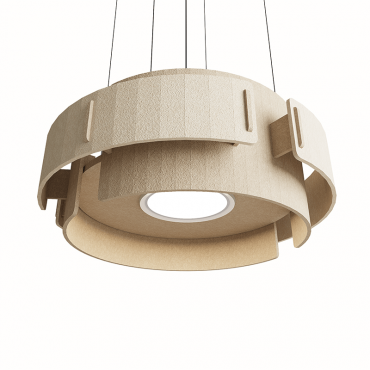
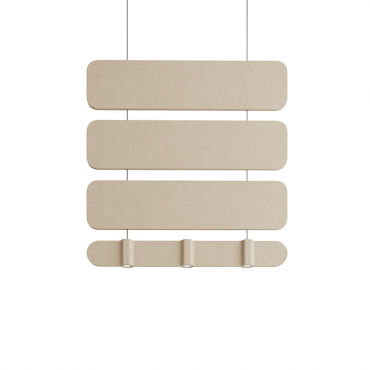
This is the most common type. The structure consists of flat or three-dimensional panels suspended on cables or rods. A classic example is the Plus Minus acoustic pendant: a modular system where individual elements can be arranged in linear or square configurations. Made from recycled plastic, available in 16 colours, price range UAH 21,000–32,000.
These models work well for open-plan offices and meeting rooms. They look structured and clean, fitting naturally into minimalist or corporate interiors. The number of elements in a configuration adapts to the room area — you can start with one panel and expand the system over time.
The advantage of panel models is a predictable noise-reduction effect. The surface area of absorbing material is easy to calculate in advance. Installation is standard, with no complex mounting hardware.
Artistic decorative (Faceted Lamp, Living Lamp)
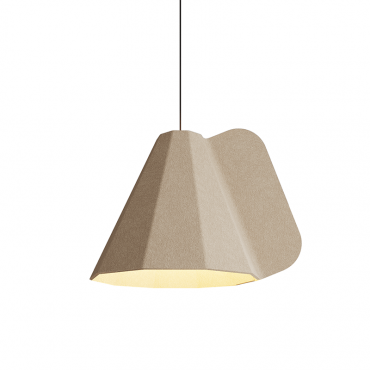
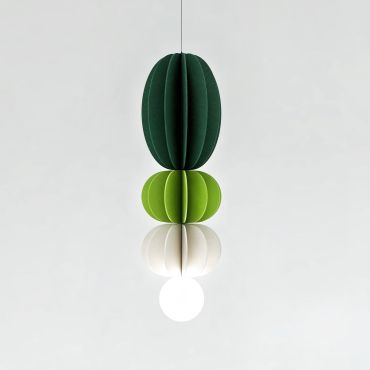
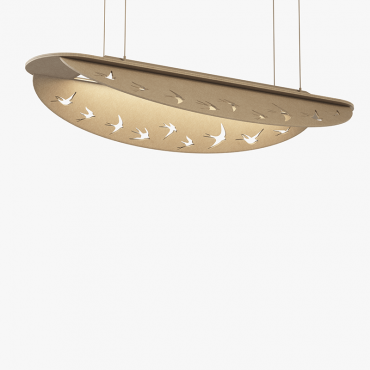
This type is closer to an art object than to functional lighting in the conventional sense. The Faceted Lamp has a multi-faceted geometric form — cut planes that create a complex surface. The Living Lamp hints at organic shapes, resembling a cloud or a smooth stone. Both products are made from PET felt, either by hand or in small production runs.
They become the central element of an interior — above a dining table, in a lounge area, in a hotel lobby or restaurant. A guest sees it first and remembers it. For commercial spaces where identity matters, it is an ideal choice.
These models are more expensive than panel types: the Living Lamp in top configurations reaches UAH 37,000–38,000. But it is a designer object with a built-in acoustic function, not merely a light fitting.
Linear and minimalist
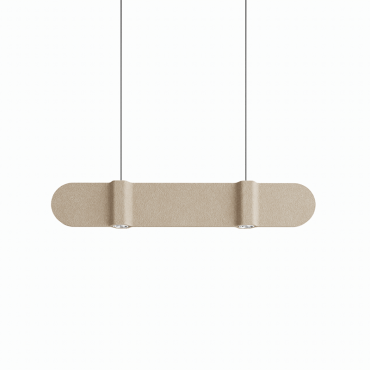
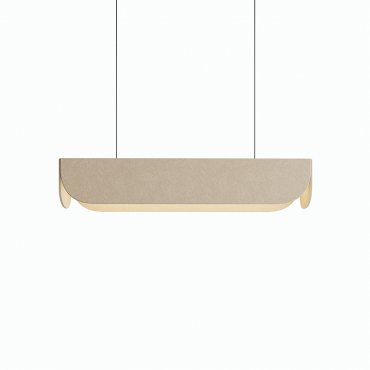
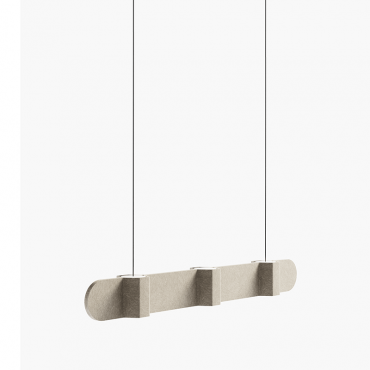
Linear models are elongated suspended elements installed in rows above workstations or along a bar counter. They fit neatly into a space without dominating it, while doing their job: illuminating and absorbing. Well suited to open kitchens, long boardroom tables and co-working desks.
Minimalist solutions have simple geometry — cylinder, disc, rectangular slab. A good choice for Scandinavian or japandi interiors, where every detail must be functional and quietly beautiful. The price range starts from UAH 4,700 for basic linear models in PET felt.
Materials: what acoustic lights are made from
The material determines both the appearance and the acoustic performance of the product. We see in practice that most buyers focus first on shape and colour, and only afterwards ask about materials. The better approach is the opposite. The material is what determines whether there will be any acoustic effect at all.
PET felt — 24 colours, eco-friendly
PET felt is the most common material for acoustic felt lights. It is made from recycled PET plastic bottles: fibres are pressed together without adhesive, forming a dense textile. The material is soft, flexible, lightweight and holds its shape well.
The key advantage is the colour palette. Standard collections offer 16 to 24 shades: neutral greys, sand, white and beige alongside rich emerald, terracotta and ochre. This makes it possible to match acoustic felt lights to any colour concept without compromise.
In acoustic terms: PET felt at 9–12 mm thickness delivers an NRC in the range of 0.65–0.85. That is a strong figure for a suspended element. The material does not trap dust and is easy to clean — important for kitchen zones and restaurants.
One more important detail: PET felt is a responsible choice. Reclaimed raw material, production without toxic components, long service life. This aligns with the circular economy principles that we at MAIIMO support consciously, not as a marketing argument.
Recycled plastic — giving materials a second life
Hard recycled plastic is used primarily in structural models such as the Plus Minus acoustic pendant. It is denser than felt, produces sharper geometric forms and offers higher mechanical strength.
The acoustic properties of recycled plastic are somewhat lower than those of felt (NRC ~0.50–0.65), but the structure compensates with greater surface area. The colour palette generally runs to 8–16 shades.
An important point: acoustic light fixtures made from recycled plastic are not a budget option or a compromise. This is a deliberate choice by the manufacturer — one that gives bottles and industrial waste a second life. Models made from recycled plastic have a cleaner, more understated look, closer to corporate or industrial aesthetics.
How to choose an acoustic pendant light: key criteria
We at MAIIMO help with selection regularly. Here is what to focus on first — in order of importance.
Room area and number of units
One acoustic pendant light is effective across roughly 15–25 m² of open space, depending on the model and material. For an open-plan office of 100 m², a minimum of 4–6 units. For a 20 m² meeting room, 1–2 is enough.
If the room already has other acoustic elements — wall panels, soft furnishings, rugs — the number of acoustic pendant lights can be reduced. If ceilings are concrete, floors are hard and there is no absorbing element anywhere, increase it. We recommend not skimping on one or two extra units: it is hard to over-achieve the acoustic effect, but buying too few is the most common mistake on a first purchase.
Colour temperature and light output (LED)
Acoustic pendant lights in most models come with a built-in LED source. Two parameters to pay attention to: colour temperature and light output.
Colour temperature: 2700–3000 K is warm light, suitable for restaurants, living rooms and bars. 3500–4000 K is neutral white, optimal for offices and meeting rooms. 5000–6000 K is cool white, rarely used in designer models and not recommended for most residential spaces.
Light output is measured in lumens. General office illumination requires roughly 300–500 lm per m². Check whether the output is sufficient for your space or whether supplementary spotlights will be needed.
Sound absorption coefficient NRC
NRC is a value from 0 to 1. The higher the figure, the better the material absorbs sound. For quality acoustic felt lights — NRC 0.65–0.85. For recycled plastic — 0.50–0.65.
Our practical rule at MAIIMO: if acoustics is the priority, choose models with NRC ≥ 0.70. If design matters more and acoustics is a welcome bonus, any model with NRC ≥ 0.50 will do. Always ask for the NRC in the specifications — if it is not listed, that is a reason to check before buying.
Acoustic pendant lights in different interior styles
This is the area in which we at MAIIMO have considerably more experience than most technical suppliers. A well-chosen designer acoustic light becomes not just a functional solution but the finishing accent that holds the entire interior together.
Minimalism and Scandinavian style
For a minimalist interior, linear or panel models in PET felt in neutral colours work best: grey, sand, white, milky beige. The form should be simple, with no extraneous details. The suspension — a thin cable or concealed rod.
In Scandinavian style, warm tones can be introduced: ochre, sage green, soft terracotta. These colours work well alongside wood and natural textiles. A model with an organic form in neutral tones is a precise fit for a Scandi living room or study.
The key principle for both styles: the acoustic pendant light should look natural, as though it was always there. Nothing superfluous, nothing strident.
Loft and industrial style
Loft interiors are an ideal scenario for sound absorbing pendant lights. Concrete ceilings, exposed brick, metal, large windows — all of this reflects sound and creates acoustic problems. Here, acoustic pendant lights solve a real issue rather than serving merely as decoration.
Dark felt shades suit a loft well: black, charcoal, deep navy, bottle green. Geometric forms and large scale are a plus. Modular configurations that can be scaled up are an excellent solution for large spaces.
In an industrial interior, an acoustic pendant light can be combined with metal conduit or exposed cabling. The key is to maintain coherence: one material, one palette, one mood.
Japandi and mid-century modern
Japandi blends Japanese simplicity with Scandinavian functionality. Organic forms, natural materials and a muted palette are the hallmarks of this style. Acoustic pendant lights in PET felt in shades of grey-green, terracotta or off-white are a precise match.
In japandi interiors we recommend avoiding bright colours and sharp geometry. One large organic model works better than several small ones.
Mid-century modern is bolder. Saturated colours are appropriate here: mustard, emerald, cherry. The form — rounded or conical. An acoustic object in this style becomes a conscious nod to the classics of the 1950s and 60s, but with contemporary function and materials.
Contemporary eclectic and soft modern
Eclectic style is the most challenging to curate but the most liberating. Here a vivid felt colour, an unconventional form or an individual Faceted Lamp that becomes a conversation piece are all valid choices.
Soft modern is a gentle contemporary aesthetic without strict stylistic boundaries. Pastel tones, rounded forms, natural materials. Soft felt colours suit it well: powder pink, pale blue, muted green. The form — rounded or textile in appearance.
In any eclectic interior, we advise selecting acoustic pendant lights to match three or four colours already present in the space, rather than the other way around.
Where acoustic pendant lights are installed
Office and open space
This is the primary market for acoustic pendant lights in Ukraine and globally. In open-plan offices with ceilings of 3+ metres, hard floors and glass partitions, noise levels become a real productivity problem. Acoustic lights for office spaces solve it without structural renovation or a separate acoustics budget.
The standard installation layout: in rows above workstations or in breakout areas. We recommend at least one acoustic light for open space per every 20 m² of open floor area. In conference rooms — a minimum of 2–4 units depending on size.
Acoustic panels with light are the optimal choice for meeting rooms where video calls are held regularly. One installation serves as both lighting and acoustic treatment simultaneously.
Restaurant, café, bar
Restaurants are the second most important segment. Noise in venues with open kitchens or large dining rooms is a classic problem. Acoustic lights for restaurant settings solve it and simultaneously become part of the signature design.
Designer models — Faceted Lamp, Living Lamp — become the centrepiece of a restaurant interior. The guest does not know it is "acoustics." They simply feel that it is more comfortable to have a conversation here than at the place next door.
For cafés and bars: warm 2700–3000 K light and saturated felt colours — terracotta, emerald, olive. For fine dining restaurants: neutral tones and minimalist forms. For co-working cafés: linear or modular configurations.
Apartment and private home
Acoustic pendant lights for home are a growing trend in Ukraine. The most relevant scenarios: an open-plan kitchen and living area with hard surfaces, a child's room (reducing reverberation improves sleep quality and concentration), a home office, or a recording or practice studio.
In a standard apartment with ceiling height up to 2.7 m, the effect of one or two acoustic pendant lights will be local but noticeable. Especially pronounced where there is parquet, tiles or a large amount of glass and reflective surfaces.
We see in practice that acoustic lights for home are most often chosen by people already familiar with acoustics — musicians, designers, architects. But this product is relevant to anyone who wants to address lighting and make a space quieter and more comfortable at the same time.
Common mistakes when choosing acoustic pendant lights
We have collected the most common mistakes so you do not have to repeat them.
Buying one unit for a large space. One acoustic pendant light in an 80 m² room is aesthetics, not acoustics. For a real effect, systematic installation is needed: at least 1 unit per 20 m² of open space. If the budget is limited, three accessible models will outperform one expensive but solitary fixture.
Ignoring NRC. A beautiful colour and form are good. But if NRC is not stated or is below 0.50, the acoustic effect will be minimal. Always ask for the sound absorption coefficient — it is the key technical specification.
Choosing a colour that is too vivid or too contrasting. Sound absorbing pendant lights are hung in a prominent position. An overly saturated colour can disrupt the balance of an interior. We recommend testing colour samples in the actual lighting conditions of the room before ordering.
Wrong LED colour temperature. Warm 2700 K in a cool modern office, or cold 6000 K in a restaurant — these are basic errors. Light temperature shapes atmosphere just as much as the colour of the body.
Incorrect mounting height. Both acoustic performance and lighting comfort depend on suspension height: 60–70 cm from the work surface for office zones, 80–100 cm from the floor for lounge areas. Too low is uncomfortable. Too high reduces the lighting effect and part of the acoustic benefit.
Buying without a consultation. Designer acoustic lights are not an off-the-shelf insert — they are part of a holistic solution. Share a floor plan or photo of the space before ordering. We at MAIIMO always advise — free of charge, with no obligation.
Why buy acoustic pendant lights from MAIIMO
MAIIMO is not just a store. We build our catalogue around a specific idea: quality design, responsible production and real function.
In our catalogue, acoustic pendant lights come from manufacturers we select personally. Among them are the Plus Minus and Faceted Lamp models from leading Ukrainian producers in this niche, alongside designer solutions from local craft studios. This is not mass-market import — it is a curated collection with a genuine rationale behind every product.
We help match the right product to a specific interior. Have a floor plan or a photo? We will advise on quantity, configuration and colours. Free of charge. No pressure.
All materials in our range are eco-conscious: PET felt from reclaimed raw material, recycled plastic. We deliberately avoid manufacturers who do not disclose the composition and origin of their materials. For us this is a matter of principle, not a marketing argument.
Buy acoustic pendant lights from MAIIMO — convenient and reliable: order online, delivery across Ukraine. For those in the capital, acoustic lighting from Kyiv-based stock is available for same-day pickup.
Our prices match the quality. We are not the cheapest, but we do not offer expensive products without a real justification. Every model comes with an explanation: what is included, why it costs what it does, what to pay attention to. We want every purchase to be an informed one.
10 FAQ — acoustic pendant lights
What is an acoustic light fixture and how does it work?
An acoustic light fixture is a suspended LED pendant whose body is made from porous sound-absorbing materials — PET felt or recycled plastic. Sound waves enter the material structure and convert into heat, which is how noise absorption occurs. At the same time, the built-in LED module provides illumination with the desired colour temperature.
The effect depends on the surface area of the material, the NRC coefficient and the number of units in the room. One acoustic pendant light will deliver a local result; a system of four to six units will produce a noticeable improvement in acoustics throughout the entire space. This is not a full substitute for acoustic panels, but a significant improvement over conventional lighting.
How is an acoustic pendant light different from a regular pendant?
A regular pendant has a rigid body — metal, glass, ceramics — that is either neutral to sound or reflects it. An acoustic pendant light has a soft porous body made from PET felt or recycled plastic that physically absorbs sound waves.
Visually, the difference lies in texture and character: an acoustic pendant looks softer, often resembling a textile or sculptural object. In acoustic terms the difference is fundamental: sound absorbing pendant lights genuinely reduce reverberation where a rigid body does not.
What materials are acoustic pendant lights made from?
Two main materials: PET felt and recycled hard plastic. PET felt is made from recycled plastic bottles — lightweight, flexible, available in 16–24 colours, NRC 0.65–0.85. Recycled plastic is denser, produces sharper geometry, used in structural models such as Plus Minus, NRC 0.50–0.65.
Both materials are a responsible choice: reclaimed raw material, minimal carbon footprint, long service life. Acoustic felt lights are more popular in residential and restaurant settings. Acoustic light fixtures in recycled plastic suit corporate and office environments.
What spaces are acoustic pendant lights suitable for?
Most effective in spaces with hard surfaces and an open ceiling: acoustic lights for office environments including open-plan areas, meeting rooms and conference halls. Acoustic lights for restaurant and café settings where kitchen noise and conversation overlap.
In residential spaces: acoustic pendant lights for home work well in living rooms with high ceilings, open-plan kitchens, children's rooms and home offices. The greatest effect comes where there is parquet, tile or a significant amount of glass and reflective surfaces.
How much do acoustic pendant lights cost in Ukraine?
Acoustic lights in Ukraine span a wide price range: from UAH 4,700 for basic minimalist models in PET felt up to UAH 32,000–38,000 for designer solutions. Plus Minus — UAH 21,000–32,000 depending on configuration. Faceted Lamp — approximately UAH 10,000.
Price depends on size, material, number of modules and manufacturer. We recommend not cutting costs on quantity: buying several accessible models and achieving a real acoustic effect is better than buying one expensive unit and seeing no result.
What sound absorption effect do acoustic pendant lights have?
The effect is defined by the NRC coefficient. Quality acoustic felt lights deliver NRC 0.65–0.85 — meaning the material absorbs 65 to 85% of sound waves in the relevant frequency range. In practice, a system of 4–6 sound absorbing pendant lights in a 100 m² room reduces reverberation time by 20–40%.
The tangible result: conversations become clearer, background noise recedes, people no longer need to raise their voices. For full acoustic control, acoustic pendant lights are best combined with wall or ceiling panels — this amplifies the overall effect considerably.
Are acoustic pendant lights suitable for a home?
Yes, and we see this segment growing. Acoustic pendant lights for home are most relevant where there is echo and background noise: an open-plan kitchen and living area, a room with parquet and glass surfaces, a home office or studio.
In a standard apartment with a 2.7 m ceiling height, one or two acoustic pendant lights will deliver a local but noticeable effect. For a comprehensive acoustic solution, combine them with soft furnishings and rugs. The added benefit: designer acoustic lights look beautiful and become a focal point in any interior — a conscious choice, not a trade-off.
How do you position an acoustic pendant light correctly?
Three practical rules. First — suspension height: 60–70 cm from the work surface for office zones, 80–100 cm from the floor for lounge areas or in line with the overall room proportions.
Second — place above the most active zones: above meeting tables, dining tables and lounge areas — wherever people gather most and where noise is most critical. Third — distribute evenly: do not cluster all acoustic pendant lights in one corner. Spreading them across the floor area produces a far better acoustic result than concentrating them in one spot.
Can an acoustic pendant light be ordered in a custom colour?
It depends on the manufacturer and model. Most products in our catalogue are available in standard palettes of 16 or 24 colours. For some models, custom shades are possible — matched to a RAL or Pantone reference — for specific projects.
If you need a designer acoustic light matched to a brand colour or a specific interior colour scheme, contact us at MAIIMO. We will clarify what is possible from each manufacturer and the lead times involved. For commercial projects — restaurants, hotels, offices — we process custom orders regularly.
How many acoustic pendant lights do I need for a 50 m² office?
For an open-plan office of 50 m², we recommend 2–4 units of acoustic lights for office use. The precise number depends on ceiling height, the presence of other acoustic solutions and the noise level in the room.
Base calculation: 1 unit per 15–25 m² of open space. Concrete ceilings, hard floors, no rugs — closer to 1 per 15 m². Soft furnishings or partitions present — 1 per 20–25 m² is sufficient. Acoustic lights for open space perform better as a system: not one unit, but at least three or four — then the acoustic effect is felt throughout the entire space, not just locally.